

×
In Part 1, we explored cardiac troponin (cTn) I assay design from the perspective of epitope selection, where both capture and detection antibodies in the sandwich pair recognize defined amino-acid regions on the cTnI molecule itself.
Following myocardial infarction (MI), however, cTnI released into the circulation does not remain in a single, unchanged molecular form. For assay developers, this means that selecting an antibody pair is not only about where the capture and detection antibodies bind on cTnI, but also whether those binding regions remain intact and accessible as circulating cTnI changes over time.
This raises another question:
Hytest scientists have studied the molecular composition of cardiac troponin in samples from myocardial infarction (MI) patients using gel-filtration techniques. These studies demonstrated that circulating cTn exists as a mixture of different molecular forms rather than as a single, uniform molecule.
Larger ternary cTnI–cTnT–TnC (ITC) complexes can progressively break down into smaller and partially fragmented complexes. Further degradation can give rise to binary cTnI–TnC (IC) complexes and free cTnT fragments. Importantly, the relative proportions of these circulating forms can also change over the course of MI.
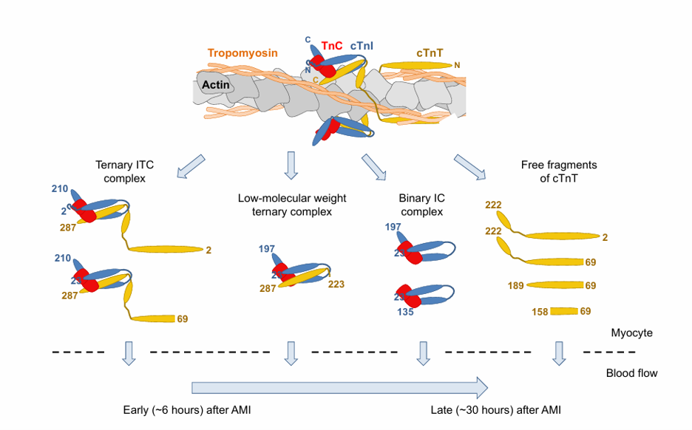
This opens another possibility for immunoassay design: cTn complex-dependent recognition.
Complex-dependent recognition is not simply about targeting another amino-acid region of cTnI. Instead, it takes advantage of structural features associated with cTnI when it is present within a troponin complex.
In this way, antibody selection can consider not only where an antibody binds on the cTnI sequence, but also the molecular context in which cTnI is present.
Hytest’s work on cTn complexes spans nearly three decades. In 1997, Hytest scientists Katrukha et al. demonstrated that most circulating cTnI in patients with acute myocardial infarction (AMI) was associated with other troponin components, establishing an early understanding of the importance of different molecular forms of circulating cTnI in immunoassay development.
Translating this biological insight into antibodies capable of recognizing cTnI in the context of Tn complexes presented a distinct technical challenge. Such antibodies needed to recognize structural features associated with the complex form rather than simply an epitope on an individual Tn component. Following continued antibody development and characterization, Hytest introduced its first anti-cTn complex antibody in 2012.
Since then, Hytest scientists have continued to expand this understanding through extensive research on cTn forms and their implications for immunoassay development. Representative studies include the characterization of full-size cTnI and its proteolytic fragments in patient blood by Katrukha et al. (2018), followed by further investigation of full-size and partially truncated cTn complexes by Vylegzhanina et al. (2019). Subsequent studies by Katrukha et al. (2021, 2023) explored the release and fragmentation of cardiac troponins following MI. (See Hytest scientific publications on troponin for the full list.) These representative studies illustrate the continued evolution of Hytest’s research into circulating cTn forms and their implications for immunoassay development.
Today, the Hytest anti-cTn complex antibody family includes:
Hytest evaluates these antibodies together with well-characterized cTnI antibodies recognizing defined epitopes, allowing complementary recognition principles to be combined within the same assay design.
Based on these evaluations, Hytest has developed antibody pair recommendations incorporating selected anti-cTn complex and cTnI antibodies in different assay architectures, including 1+1, 2+1, and 2+2 formats for assay development on CLIA and lateral-flow (LF) platforms.
These combinations can also provide useful starting points for high-sensitivity cardiac troponin I (hs-cTnI) assay development, where robust recognition of the heterogeneous molecular forms of circulating cTnI is particularly important at very low analyte concentrations.
For further background on cTn biology, antibody recognition, and assay development, see our Cardiac Troponin I Booklet.
For further information about Cat. # 4TC2 and Cat. # RC4TC2, including the product Datasheets, please visit the Cat. # 4TC2 product page and the Cat. # RC4TC2 product page.
To access the full list of recommended antibody pairs, please contact the Hytest North America Sales team.



Copyright © Hytest Ltd.